Showing posts with label Buddhist Tour Places. Show all posts

Tuesday, November 15, 2011

Gaya - Bodh Gaya Tourist Places to visit | Mahabodhi Temple | VishnuPada Temple Tour | Buddhist Temples of Visit | Lord Buddha


The holy town of Gaya, is the second largest city of Bihar, India, and it is also the headquarters of Gaya District. Historically, Gaya was the part of the ancient Magadh Empire.

Gaya is located 100 kilometers south of Patna, the capital city of Bihar. The city is serenely placed on the banks of Falgu River, is a place sanctified by both the Hindu and the Buddhist religions. The Town is on a slightly raised ground in the valley between the Ramshila and Pretshila Hilla. It is surrounded by small rocky hills (Mangla-Gauri, Shringa-Sthan, Ram-Shila and Brahmyoni) by three sides and the river flowing on the fourth (eastern) side. An essential transit point to Bodhgaya, Gaya is a densely packed town. The city has a mix of natural surroundings, age old buildings and narrow bylanes. 

It is believed that this place has been blessed by Lord Vishnu with purificatory powers and is a major religious tourist place among Hindu’s. Perhaps it is the most auspicious place considered in Hindu sect to perform the ritual of Pind Dan or Oblation, a holy act in Hindu religion to ensure peace of the departed souls of twelve generation of their deceased ancestors. Even the followers of Buddhism also visit Gaya as the famous seat of Buddhism, 'Bodh Gaya' is few kms away from Gaya. Apart from having a religious significance, it wins over the tourists for its no-frill appearance, serene setting and a relaxed pace of life. 

Gaya derives its name from the mythological demon Gayasur (which literally means Gaya the demon). Lord Vishnu killed Gayasur, the gentle demon by using the pressure of his foot over him. This incident transformed Gayasur into the series of rocky hills that make up the landscape of the Gaya city. Gaya was so holy that he had the power to absolve the sins of those who touched him or looked at him; after his death many people have flocked to Gaya to perform Shraddha sacrifices on his body to absolve the sins of their ancestors. Gods and goddesses had promised to live on Gayasur's body after he died, and the hilltop protuberances of Gaya are surmounted by temples to various gods and goddesses. These hilltop temples at Rama Shila, Mangla Gauri, Shringa Sthan and Brahmayoni are part of the pilgrimage circuit, and grand staircases have been built up to most of them. Like Varanasi, and many other riverside towns, Gaya is said to be a 'tirtha' - a crossing across the celestial divide.

Places of Interest in Gaya

Akshayabat
Akshyabat is the immortal Banyan tree that stands in the courtyard of the temple and located 12 kms away from Gaya.  The tree situated in the the Bodh Gaya is of immense significance as it was under this tree, Buddha is said to have meditated. Also, the final rites for the dead are held beneath it.

Archaeological Museum

This small museum housing collection of sculptures, bronzes, terracottas, paintings, arms and manuscripts is near the tank. It is open from 10 am to 5 pm on all days except Monday.

Vishnupad Temple

Vishnupad Temple is one of the major attractions in Gaya. This massive temple located in the central part of the old town is believed to have been built over the footprints of Lord Vishnu. Inside the temple, the 40 cm long `footprint' of Vishnu is imprinted in solid rock and surrounded by a silver plated basin. The temple with its 30m high silver plated octagonal peak is resting on eight rows of decorated pillars, was built in Shikhara style of architecture in the year 1787. Dedicated to Lord Vishnu, it was constructed by Ahilay Bai Holkar of Indore. Non-Hindus are not allowed to enter the temple. A flight of 1000 stone steps leads to the top of the Brahmajuni Hill, 1 km south-west of the Vishnupad Temple that presents a splendid view of the temple. 

The temple complex is quite big and houses many images of different Gods and Goddesses. There are many other shrines in and around the temple. Another important temple is of Lord Nrisimha, the god which according to Hindu mythology was a man-lion incarnation of Lord Vishnu. The temple and statue is intricately carved and designed and is a major tourist attraction at Gaya.

Surya Kund

Surya Kund is another tourist attraction. Devotees visit in large numbers as they believe that a holy dip in the pond remits the sin. The temple is situated on the west side of the Vishnupad temple. During Chath Puja, devotees visit in large number to worship the Sun God after taking a dip in the holy Kund. 

Brahmayoni Hill or Gayasirsa

Brahmayoni Temple located just one km away to the southwest of the Vishnupada Temple. One has to climb up 424 high stone steps to reach the top of the hill. The temple perched atop a hill offers breathtaking view of the city below. There are two caves Brahmayoni and Matreyoni on the hill and an ancient temple of Astabhujadevi. 

Barabar Caves

Barabar Caves date back to second century BC, located 25 kms of Gaya, are the treasures of Bihar and are set in wild and inhospitable environs. These caves were built by Ashoka, the Great for Ajivikas. Loma Rishi cave happens to be the most splendid

Bodhgaya Town

Lying 13 kms south of Gaya, this place is of immense importance to the Buddhists, as Lord Buddha attained his enlightenment here.

The life of Gautam Buddha, the founder of Buddhism, is associated with the small town of Bodhgaya. It is one of the four holiest cities of Buddhist faith. The Mahabodhi temple is the main attraction of this town and is located near the spot where Lord Buddha attained spiritual enlightenment. Bodhgaya is not only an important Buddhist pilgrim center, but it is also an important center for the study of Buddhism. 

Mahabodhi Temple and other monasteries are the major attractions in Bodhgaya. Places associated with the life and times of Lord Buddha are located inside the Mahabodhi complex including the Bodhi Tree and a pond where according to legends, Lord Buddha mediated for few days. 

Mahabodhi Temple 

The Mahabodhi Temble is located at the place of Lord Buddha's enlightenment. The temple has a 50m (170 ft) tower. The present temple was restored around 1880. There have been several other temples on this site. A previous temple was destroyed by the Muslims in the 11th century. Parts of the intricately carved railings to the south and west of the temple are very old. Some of the railings are original and parts of the railings are reproductions.  In the inner sanctuary there is a huge Buddha. In the center of the temple there is also a Siva-linga that was installed about 860. This temple is also sacred to the Hindus because Lord Buddha is the ninth incarnation of Lord Vishnu. 

Bodhi Tree 

The Bodhi tree here is said to be a descendent of the tree under which Budhha attained enlightenment. A sapling of the original bodhi tree that the Buddha sat under was carried by Emperor Ashoka's daughter (Sanghamitta) to Sri Lanka. That tree is at Anuradhapura in Sri Lanka. A cutting from that tree was planted in Budha Gaya when the original tree died. Under the tree is a red sandstone slab that is said to be the Vajrasana, the diamond throne, that Buddha sat on and attained nirvana. The tree is located behind the temple and is about 80 feet high and about 115 years old. 

Thursday, October 6, 2011

Ellora Caves Tour, Ajanta Ellora Caves, Places to visit in Maharashtra

The Ajanta and Ellora Caves are the ancient repository and Indian architectural heritage pride of Maharashtra, India. Both these sites are world famous and are cut in rocks. These caves are marvelous example of the highest degree of skills and artistry that Indian craftsmen had achieved several hundred years ago with primitive tools. Ajanta dates back 100 B.C. while Ellora is younger by some 600 years.


Ellora Caves are close to the modern time city Aurangabad in Maharashtra. Aurangabad City was founded in 1610, on the site of a village, Khirki by Malik Ambar and has always been a prominent region on the Deccan plateau. Having been inhabited since the Stone Age, it has a long artistic and cultural history - to which several dynasties have made major contributions over the years. Maurya rule marked the arrival of Buddhism in Maharashtra.

Ajanta and Ellora caves were shrouded in ignominy for over a millennium, till John Smith, a British Army Officer stumbled upon them while on a hunting expedition in 1819. Today Ajanta and Ellora caves have been honored the world heritage site status to be preserved as an artistic legacy for generations to witness. 

Ellora Caves

Ellora Caves is an archaeological site, 30 km from the city of Aurangabad in the Indian State of Maharashtra, India. The Caves were carved under patronage of the then Rashtrakuta dynasty. Ellora, With 34 caves devoted to Buddhist, Jain and Hindu faiths, represents the epitome of Indian rock cut architecture. Ellora caves are carved into the sides of a basaltic hill. As the finest specimens of cave temples, Ellora caves have elaborate facades and intricately aesthetic interiors to hypnotize your sensibilities. The name Ellora itself inspires everyone as it represents one of the largest rock-hewn monastic-temple complexes in the entire world. Ellora is also world famous for the largest single monolithic excavation in the world, the great Kailasa (Cave 16).   The  12 Buddhist ( Caves 1 to 12), 17 Hindu (Caves 13 to 29) and 5 Jain (Caves 30 to 34) Caves, built in proximity, demonstrate the religious harmony prevalent during this period of Indian history.


The caves were carved out of a slope in the hill in a north–south direction. They face west, so they receive light from the setting sun. All the caves were carved from the top to the bottom, so workers did not require scaffolding.

For some unknown reason, Ajanta was abandoned around the 7th century and the people making the caves moved to Ellora, 100km south.

The period of construction of these caves is in following order:

Buddhist Caves: 

5th century to 7th century AD
Caves 1 to 12 at the southern end

Hindu Caves: 

8th century to 10th century AD
Caves 13 to 29 in the middle

Jain Caves:
9th century to 11th century AD
Caves 30 to 34 at the northern end

The Buddhist Caves

It was initially thought that the Buddhist caves (also called Vishvakarma Caves) were one of the earliest structures, created between the fifth and eighth centuries, with caves 1-5 in the first phase (400-600AD) and 6-12 in the later phase (mid 7th-mid 8th), but now it is clear to the modern scholars that some of the Hindu caves (27, 29, 21, 28, 19, 26, 20, 17 and 14) precede these caves. The earliest Buddhist cave is Cave 6, followed by 5, 2, 3, 5 (right wing), 4, 7, 8, 10 and 9. Caves 11 and 12 were the last. All the Buddhist caves were constructed between 630-700 AD. All except Cave 10 which is a chaitya (temple), are Viharas (monasteries), which were used for study, meditation, communal rituals, eating and sleeping. The caves are not as architecturally interesting as the Hindu caves.

Cave 1 

The cave is a plain vihara with eight small cells, four in the back wall and four in the right wall. It may have served as a granary for the other viharas.

Cave 2

The cave is much more impressive. A large central chamber supported by 12 great square pillars is lined with sculptures of seated Buddhas. There are two large, standing dwarapalas (door guards).  Inside the cave, the shrine is a stately seated Buddha and two standing Buddhas, while along each of the side walls are five Buddhas accomplanied by Budhisattvas seated under trees.

Caves 3 and 4 

These caves have a similar design as Cave 2, but are in poor condition.

Cave 5

The cave is named as the Maharwada Cave because it was used by local Mahar tribes people as a shelter during the monsoon. The shrine Buddha is seated on a stool with his right hand touching the ground in the Earth Witness gesture.

Cave 6

The cave is home to two of the finest sculptures at Ellora. On the left is the goddess Tara, with an intense but kind expression. Opposite her on the right is Mahamayuri, the Buddhist goddess of learning, shown with her attribute, the peacock. A diligent student sits at his desk below.  The boundaries between religions melt here as Hindu’s consider Buddha as the incarnation of their Vishnu and Mahamayuri as Saraswati, the Hindu Goddess of learning.

Cave 7

The cave is in for of an austere hall with pillars, is the first a two- storied cave.

Ellora-Caves 8-9

These two caves have nothing special.

Cave 10

The cave 10 is the most famous of the Buddhist caves. The magnificent Cave 10 dates from the early 700s AD and is known as the “Suttar Jhopadi or Carpenter’s Cave”, a tribute to Visvakarma, the architect of Demi Gods. At the far end, a seated Buddha is enthroned in front of a large stone stupa.  The hall has a vaulted roof in which ribs have been carved in the rock imitating the wooden ones. Decorating the walls are loving couples indicating how much Buddhism had changed from its early ascetic days.

Cave 11 

This cave is known as the Dho Tal or "Two Floors" cave. The lowest level (basement) is a veranda with a shrine and two cells at the back of it., The middle level has eight front pillars and fiver rear cells of which only the central are completed and decorated. The top floor is a long assembly hall lined with columns. It has both a Buddha shrine and images of Durga and Ganesh, indicating the cave was converted into a Hindu temple after it was abandoned by the Buddhists. The third storey which was discovered later has cells for sleeping (note the stone benches) on the lower floors but it is the figures of the Buddha which are of particular interest. The rows of seven Buddhas are symbolic of the belief that he appears on earth every 5000 years and has already visited it seven times. 

Cave 12

The cave is known as “Tin Thal or three storeyed”. The cave has cells for sleeping (stone benches) on the lower floor.  The walls of the shrine room are lined with five large bodhisattvas and are flanked by seven Buddhas. The rows of seven Buddhas are symbolic of the belief that he appears on earth every 5000 years and has already visited it seven times.

The Hindu Caves

The Hindu caves were constructed between the middle of sixth century to the end of the eighth century. The Hindu Caves are more impressive, profusely sculptured with Shiva and Vishnu Images. The caves are covered lively with the Hindu scriptures. All of the caves are dedicated to the God shiva, but there are also some images of Vishnu and his various incarnations.  The caves created during a time of prosperity and revival of Hinduism, represent entirely different style of vision and skill than of Buddhist caves. The early caves (caves 17–29) were constructed during the Kalachuri period.  The caves occupy the center of the cave complex, grouped either side of the famous Kailasa Temple. Some were of such complexity that they required several generations of planning and co-ordination to complete.

Cave 13

This cave marks the first of those caves carved by the Hindus.  It’s a simple, plain room. 

Cave 14

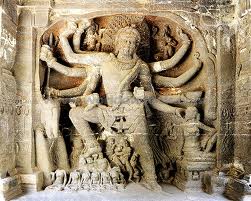
The cave known as Ravana ki khai, seventh century, is single storeyed and the last of the collection from the early period. The cave has sculptures of Varah (half-boar), Laxmi and Shiva.  At the entrance of the sanctum are sculptures of the river goddesses Ganga and Yamuna. Nearby are carvings of the Sapta Matrikas. On the right wall there are carvings of Shiva as playing chess, Dancing Tandava and ignoring Ravana’s attempt to shake Mount Kailash.

Cave 15

The cave named “Dashavatara or ten incarnation of Lord Vishnu” is a Buddhist monastery later modified for Hindus.  The various avatars of Vishnu narrate numerous tales while Shiva rides the divine chariot and prepares to destroy the palaces of the demons. There is a Nandi bull and many sculptures. On the upper floor are some of the most outstanding carvings, including Lord Narasimha (Lord Vishnu as half lion) Lord Vishnu rescuing Gajendra, the elephant.

Cave 16 Kailasanatha

The Cave, is also known as the Kailasa or the Kailasanatha, is the centerpiece of Ellora. It is the largest monolithic structure in the world. This is designed to recall Mount Kailash, the abode of Lord Shiva and looks like a freestanding, multi-storeyed temple complex, but it was carved out of one single rock.  


In the cave and within the courtyard are three structures. As is traditional in Shiva temples, first is large image of the sacred bull Nandi in the front of the central temple. In the Nandi Pavilion facing the entrance is a beautiful carving of Lakshmi surrounded by adoring figures seated in a pond, she is being bathed by elephants carrying pots in their trunks. Also be on the lookout for mithunas- male and female figures in erotic situations. Central temple - Nandi Mandap - is housing the lingam. Nandi Mandap stands on 16 pillars. The base of the Nandi Mandap has been carved to suggest that life-sized elephants are holding the structure aloft. A living rock bridge connects the Nandi Mandap to the Shiva temple behind it. The temple itself is tall pyramidal structure reminiscent of a South Indian Dravidian temple. The shrine, complete with pillars, windows, inner and outer rooms, gathering halls, and an enormous lingam at its heart – carved from living stone, is carved with niches, pilasters, windows as well as images of deities. Most of the deities at the left of the entrance are Shaivaite (followers of Shiva) while on the right hand side the deities are Vaishnavaites (followers of Vishnu). There are two Dhvajastambhas (pillars with the flagstaff) in the courtyard. The grand sculpture of Ravana  attempting to lift Mount Kailasa, the abode of Lord Shiva, with his full might is a landmark in Indian art. The construction of this cave was a feat of human genius – it entailed removal of 200,000 tonnes of rock, and took 100 years to complete.

Other Hindu caves

Other notable Hindu caves are the Rameshvara (Cave 21), which has figurines of river goddesses Ganga and Yamuma at the entrance and the Dhumar Lena (Cave 29) whose design is similar to the cave temple on Elephanta Island near Mumbai. Two other caves, the Ravan ki Khai (Cave 14) and the Nilkantha (Cave 22) also have several sculptures. The rest of the Hindu caves, which include the Kumbharvada (Cave 25) and the Gopilena (Cave 27) have no significant sculptures.

The Jain Caves

The five Jain caves at Ellora belong to the ninth and tenth centuries. They all belong to the Digambara sect. These caves reveal specific dimensions of Jain philosophy and tradition. These Caves are an anticlimax after the Hindu ones, but they have an aura of peace and simplicity. These caves are not as large as compared to others, but they present exceptionally detailed artwork. The Jain caves 30 to 34 were excavated from 800AD until the late 11th century. Because of the sloping hillside, most of the cave entrances are set back from the level ground behind open courtyards and large colonnaded verandas or porches. The most remarkable Jain shrines are the Chhota Kailash (cave 30), the Indra Sabha (cave 32) and the Jagannath Sabha (cave 33). Cave 31 is an unfinished four-pillared hall and a shrine. Cave 34 is a small cave, which can be approached through an opening on the left side of Cave 33.

Cave 30

The cave 30, (Chhota Kailasa) is the largest and the first to be excavated. It’s a smaller incomplete replica of the Hindu Kailasa cave, decorated with Jain saints and goddesses; within the sanctuary is an image of the founder of Jainism, Mahavira, who sits on a lion throne.  

Cave 32, Indra Sabha

The Indra Sabha or Indra Assembly hall (Cave 32) is finest of the jain caves with two storied structure and one more monolithic shrine in its court. It’s a miniature version of Kailash Temple. It has a very fine carving of the lotus flower on the ceiling. The naked figure of the Gomatesvara, on the right, is fulfilling a vow of silence in the forest.  It got the appellation "Indra Sabha" probably because of the sculpture of the yaksha  (dedicated attendant deity) Matanga on an elephant, which was wrongly identified as that of Indra. On the upper level of the double-storied shrine excavated at the rear of the court, an imposing image of Ambika, the yakshini of Neminath, is found seated on her lion under a mango tree, laden with fruits.

Other Jain caves

All other Jain caves are also characterized by intricate detailing. Many of the structures had rich paintings in the ceilings – fragments of which are still visible.

Sunday, October 2, 2011

Ajanta Caves Tour, Ajanta and Ellora Caves Tour, Places to visit in Maharashtra, Ajanta a Buddhist Tourist Places to Visit

The Ajanta and Ellora Caves are the ancient repository and Indian architectural heritage pride of Maharashtra, India. Both these sites are world famous and are cut in rocks. These caves are marvelous example of the highest degree of skills and artistry that Indian craftsmen had achieved several hundred years ago with primitive tools. Ajanta dates back 100 B.C. while Ellora is younger by some 600 years.

The village of Ajanta is in the Sahyadri hills, about 99 kms from Aurangabad city in state of Maharashtra of India.  About 3.5 km away from village, in the hill, lays the mammoth horseshoe-formed rock with 29 caves, overlooking the gorge. Each cave forming a room in the hill and the some cave with inner rooms also. These all caves are carved in the solid hard rock by hand using hammer and chisel primitive tools, faith and inspiration of Buddhism. These caves remind the dedication, faith, commitment, unity and above all the selflessness of living humans of that period. The river Wagura, a mountain stream flows along the bottom of the ravine. This river falls from a height of 200 ft, thus making a series of waterfalls. The sound of the waterfalls can be heard in the caves also. 


Aurangabad City was founded in 1610, on the site of a village, Khirki by Malik Ambar and has always been a prominent region on the Deccan plateau. Having been inhabited since the Stone Age, it has a long artistic and cultural history - to which several dynasties have made major contributions over the years. Maurya rule marked the arrival of Buddhism in Maharashtra.

Ajanta and Ellora caves were shrouded in ignominy for over a millennium, till John Smith, a British Army Officer stumbled upon them while on a hunting expedition in 1819. Today Ajanta and Ellora caves have been honored the world heritage site status to be preserved as an artistic legacy for generations to witness. 

Ajanta caves have panels depicting tales from the Jatakas, a rich collection of stories dealing with several reincarnations of the Budhhaand as well as frescos which are reminiscent of the sigiriya  paintings in Sri Lanka, were built as secluded retreats of the Buddhist monks. These monks taught and performed rituals and prayers in the Chaityas (chapels) and lived in Viharas .Many of the caves have the most exquisite detailed carvings on the walls, pillars and entrances as well as magnificent wall paintings.  The carvings and the paintings in the caves depict the life stories of Lord Buddha. Along with this, several types of human and animal figures are also carved out of the rocks. These caves houses some of the most well preserved wall paintings including that of two great Boddhisattvas, Padmapani and Avalokiteshvara. These caves have some of the most divine sculptures and images of Budhha preaching. One can have a first hand info on the overall development of Buddhism, observing these caves.

In their range of time and treatments they provide a panorama of life in ancient India and are a source of all kinds of information hair styles, ornaments, textiles, musical instruments, details of architecture, customs etc. It was from this collection of classical Indian art that a particular style was formed that traveled with Buddhism to many parts of the world. Similar paintings can be seen in Sigiriya in Sri Lanka, Bamiyan in Afghanistan, temples and shrines in Tibet, Nepal, China and Japan.

Royal patronage made Ajanta possible. Professional artists carried out much of the work and each contributed his own individual skill and devotion to this monumental work.

Visitors often ask how the artist who painted the detailed frescoes and chiseled out the intricate carvings, managed to work in the dark interiors of the caves. It has been noticed that the caves are illuminated by natural light for part of the day and it is presumed that metal mirrors or sheets of white cloth were used to reflect sunlight into the inner recesses.

Since 1983, the Ajanta caves have been a UNESCO World Heritage Site. The Caves are about 59 kilometers from Jalgaon Railway station (on Delhi - Mumbai, Rail line of the Central railways, India); and 104 kilometers from Aurangabad (From Ellora Caves 100 Kilometers).

The Ajanta Caves

The caves are numbered from east to west, 1 through 29. Today, a terraced path connects the cave, but in ancient times each was independently accessed from the riverfront. A viewing platform across the river affords an excellent view of the entire Ajanta site. The natural beauty of the area makes it clear why the monks chose the site for their spiritual pursuits. The carvings of caves in order are estimated as below:

Phase I: 2 nd century BC to 1 st century BC

Caves 9 & 10: Chaitya Halls or shrines

Caves 12 & 13: Viharas or monasteries

Phase II: 5 th century AD to 6 th century AD

Caves 19,26 & 29: Chaitya Halls or shrines

Caves 1-7, 11, 14-18, 20-25, 27 & 28: Viharas or monasteries

Unfinished Caves: 3, 5, 8, 23-25, 28 & 2

CAVE 1

The first monastery was built on the eastern end of the horse –shoe shaped scarp.  The cave has one of the most elaborate carvings on its façade with relief sculptures on the entablature and ridge and is the most popular of the monastery caves at Ajanta. Every inch of the cave was originally painted, though much has worn away over the centuries.  The cave has a porch with simple cells on both ends. The absence of pillared vestibules on the ends suggests that the porch was not excavated in the latest phase of Ajanta when pillared vestibules had become a necessity and norm. There are three doorways, a central doorway and two side doorways. Two square windows were carved between the doorways to brighten the interiors.

Each wall of the hall inside is nearly 40 feet long and 20 feet high. Twelve pillars make a square colonnade inside supporting the ceiling, and creating spacious aisles along the walls. There is a shrine carved on the rear wall to house an impressive seated image of the Buddha, his hands being in the dharmachakrapravartana mudra. There are four cells on each of the left, rear, and the right walls. The walls are covered with paintings in a fair state of preservation. The scenes depicted are mostly didactic, devotional, and ornamental. The themes are from the Jataka stories (the stories of the Buddha's former existences as Bodhisattava), the life of the Gautama Buddha, and those of his veneration.

CAVE 2

Adjacent to Cave 1, is known for the painting that have been preserved on its walls, ceilings, and pillars, It looks similar to Cave 1 and is in better state of preservation. This monastery consists of cells, sanctum, and two pillard sub-shrines. Painting appear on almost every surface of the cave except for the floor.  While the seated Buddha in dharmacakrapravartana mudra is enshrined in the sanctum, the side sub-shrines contain two Yaksha figures (popularly known as Sankhanidhi and Padmanidhi) to the east and Hariti & her consort Pancika to the right. The façade of this Mahayana monastery cave shows the kings of Naga and their entourage. Inside, a glorious mandala dominates the ceiling, held by demons and decorated with birds, flowers, fruits and abstract designs. The ceiling gives the effect of a cloth canopy, right down to the sag in the middle.

The painted narratives of the Jatak tales are depicted only on the walls, which demanded the special attention of the devotee. They are didactic in nature, meant to inform the community about the Buddha's teachings and life through successive births. Their placement on the walls required the devotee to walk through the aisles and 'read' the narratives depicted in various episodes. The narrative episodes are depicted one after another although not in a linear order.

CAVE 3

This is an incomplete monastery and only the preliminary excavation of pillared verandah exist.

CAVE 4

This squarish monastery consists of a hall, sanctum sanctorum, pillared verandah and is datable to first half of sixth century A.D. This is the largest monastery at Ajanta measuring.


CAVE 5

This monastery is an unfinished one. However, the T-shaped richly carved door frame, and female figures on makaras are important ones.

CAVE 6

This was the first important cave of the Mahayana Phase. This is a double storied monastery (16.85 X 18.07 m) consisting of hall, sanctum sanctorum and a pillared hall in the lower storey and a hall with cells, subsidiary cells and sanctum sanctorum in the upper storey. Buddha in preaching attitude is housed in both the shrines. The depiction of Miracle of Sravasti and Temptation of Mara are the important paintings. Sculptural depiction of Buddha in various attitudes and postures can also be noticed here. The painting of Bhikshu in this cave in the middle, done about 5th century, is almost like a relief. There is the rhythmic vitality in the line and boldness of drawing. The painting is almost like a sculpture. The folds of the garment, the rounded belly, and the calm on the face suggest a devote worshipper.

CAVE 7

This monastery consists of a sanctum sanctorum, an oblong open hall with two small porticos supported by heavy octagonal pillars and eight cells. Buddha in preaching attitude is housed inside the sanctum. Other sculptural panels include Miracle of Sravasti, seated Buddha under the protection of Nagamuchalinda, etc.

CAVE 8

This is an unfinished monastery

CAVE 9

This apsidal chaityagriha is datable to second century B.C. and belongs to the Hinayana phase of Buddhism. This is a Chaitya gathering hall. The chaityagriha consists of an entrance door, two side windows, central hall, nave flanked by side aisles (pradikshana) on either side separated by a row of 23 pillars and a stupa, the object of worship.  There are two early paintings, which survive. Frieze Of Animals And Herdsmen Naga Worshippers Giant Horseshoe Window.


There is a Giant Horse-Shoe Window on the façade. The carving of this window suggests that it copied a wooden structure of the same time. The pillars and the slanting eight-sided columns are also copied from wooden structures of earlier times.

CAVE 10

The cave 10 is of the about the same time as the cave 9. It has a similar shape. The large chaitya gathering hall is 28.5m X 12.3m wide and 11m high. It has a stupa shrine at the ambulating passage around the symbolic stupa.


The cave consists of a large central hall, nave flanked by two aisles (pradikshana) separated by a row of 39 octagonal pillars and a rock stupa at the apsidal end, the object of worship. The cave consists of two period of paintings, the earlier dated to 2nd century B.C and the later 4th – 6th century A.D. Two Jataka stories of this period have been identified, namely, the Sama (Shama) Jataka and the Chhaddanta Jataka. The later period paintings contain Buddha figures in various poses mainly over the pillars.

CAVE 11

This monastery datable to beginning of fifth century A.D. consists of a hall with six cells and a long bench, a pillared verandah with four cells, a sanctum sanctorum. The Buddha in shrine of cave is one of the earliest images at Ajanta. Buddha in preaching attitude is housed in the sanctum against an unfinished stupa. The important fact about this Buddha is that it is attached to a Stupa. This means a compromise between stupa worship and image worship. Few paintings that available here depicts Bodhisattvas, figures of Buddha, etc.

This cave is interesting, because it shows the transition from the earlier Hinayana to the later Mahayana Buddhist phase of worship. The round stupa has the images of the Buddha to its bare girth.

CAVE 12

This Hinayana monastery consists of a hall. The front wall is completely collapsed sided by twelve cells arranged on three sides.

CAVE 13

This is a small monastery and belongs to the first phase. It consists of an astylar hall with seven cells on three sides. The cells are provided with rock-cut beds.

CAVE 14

This unfinished monastery was excavated above Cave 13 at a higher level. It was originally planned on a large scale. The depiction of sala bhanjikas on the top corners of doorway is beautifully depicted.

CAVE 15

The monastery consists of an astylar hall with eight cells, an antechamber, sanctum sanctorum and a pillared verandah. The sculptural depictions include Buddha in various postures, seated Buddha on simhasana inside the sanctum sanctorum. The traces of paintings indicate that it was originally painted.

CAVE 15A

Smallest of all the excavations at Ajanta this cave consists of a small central astylar hall with one cell on three sides. The front wall had an inscription in shell characters (which is now lost). The hall is relieved with chaitya window pattern rising from vedica pattern.

CAVE 16

According to an inscription found here, the excavation of this cave was caused by Varahadeva, the minister of Vakataka king Harishena (circa A.D. 475-500). The cave (19.5 X 22.25 X 4.6 m) which is a monastery consists of a central hall surrounded by 14 cells on three sides, vestibule and a sanctum for Buddha image. The important painted themes depicted are the conversion of Nanda; Miracle of Sravasti; Maya’s dream; and certain incidents from the life of Buddha. The Jataka stories depicted are Hasti, Maha-ummagga, Maha-sutasoma. Painted inscriptions can also be noted inside the caves.

Here two Goddesses stand on neatly carved pilasters The Buddha figure in the shrine is of about the same time as the Buddha in the shrine of the cave 6 (lower) and cave 11 as the Buddha in cave 16 seated with his heavy feet down the base, it is more than life size and fairly uncommon. Lions and other active animals support the throne. Bodhisattvas stand behind him. This cave gives a good view of the ravine. From the large verandha we enter a hall.

CAVE 17

The porch doorway of cave is similar to that of cave 16 with which it is contemporary. But the seated couples on both the doorjambs and lintels improve on this cave. A Brahmi inscription found here records the excavation of this cave by a feudatory prince under Vakataka king Harishena. This monastery consists of a spacious hall surrounded by 17 cells on three sides, a vestibule and a sanctum containing the image of Buddha. The T-shape shrine doorway has goddesses, supported by pilasters. This doorway is highly decorative. The plan of this cave is simple and severe. The pillars in both the porch and interior are arranged in a strict order. All the pillars were painted. The pillars near the shrine have intricate carvings. The cave houses some of the well preserved paintings, a huge and gigantic wheel representing the ‘Wheel of Life’.

The Buddha in the shrine is seated in the Yogasana. His hands are held in the Dharmachakra mudra, or teaching gesture. There are bodhisattva attendants holding flywhisks. The dwarfs bring garlands. Devotees appear with offerings. The circumambulatory passage around the image shows it is a relatively early cave. The pilasters at the right hand of the porch of this cave are fairly simple. This cave was in transition from Hinayana to Mahayana. So some survivals of symptoms of floral and geometric paintings can be seen on pilasters.

CAVE 18

This consists of a rectangular excavation  leading into another cell. The hall has two pillars with moulded bases and octagonal shafts.

CAVE 19

This chaityagriha gathering hall with many paintings and sculptures is datable to fifth century A.D. and could be the gandhakuti. The stupa is carved with a standing image of Buddha 7.

This cave is known for it sculptural grandeur of the façade and particularly the two life size Yaksha images on either sides of the chaitya vatayana (arch). The hall has painted depictions of Buddha in various postures. 

CAVE 20

A pillar less monastery consists of hall cells, sanctum sanctorum and a pillared verandah datable between A. D. 450 and 525. Buddha in preaching attitude is housed in the sanctum. The sculpture of seven Buddhas accompanied by attendants is another important sculptural panel in this cave.

CAVE 21

This monastery  consists of a hall with twelve pillars and twelve cells on three sides, sanctum sanctorum, pillared verandah (pillar’s restored now). Out of 12 cells four are with pillared porches. The sanctum house seated Buddha in preaching attitude. Trace of paintings are noticed which consist of a panel depicting Buddha preaching a congregation.

CAVE 22

This monastery consists of an astylar hall four unfinished cells, sanctum sanctorum and a narrow verandah. Buddha seated in pralamba-padasana is carved on the back wall of the shrine. The sculptural depiction of Buddha in different forms, painted figures of Manushi-Buddhas with Maitreya can be noticed here.

CAVE 23

This is an unfinished monastery .

CAVE 24

This is an incomplete monastery

CAVE 25

This monastery consists of an astylar hall, pillared verandah and an enclosed courtyard and excavated at a higher level. Two cells are noted on the left end of the verandah and the hall has no cells. The hall is devoid of shrine.

CAVE 26

This chaityagriha is quite similar to Cave 19, but of a larger dimension  and more elaborately and exquisitely provided with sculpted figures. The chaityagriha consists of a hall, side aisles (pradikshana) and a rock-cut stupa front by an image of Buddha. The highlight is a large carved statue of the reclining Buddha, representing his moment of death. Below him, his followers mourn his passing; above, celestial beings rejoice. The cave also contains a stupa with an image of the Buddha in a pavilion.

CAVE 27

This cave could have been part of Cave 26 and it consists of two storeys, the upper one partially collapsed. The monastery consists of a hall with four cells, antechamber and sanctum sanctorum. Buddha in teaching attitude is housed inside the sanctum.

CAVE 28

This is an unfinished monastery of which only the pillared verandah was excavated.

CAVE 29

This is an unfinished chaityagriha  in its first stage of excavation and located at the highest level, located between Caves 20 and 21. 

It is worth walking away from the caves in order to look back on to the horseshoe gorge. The ingenuous water cistern system can be seen which must have provided water for the monks and their visitors. Ajanta was on the ancient trade route leading to the coast so there must have been considerable activity and many visitors. Nobody really knows what life was like in those times and visitors can interpret the past as they wish, which is perhaps yet another secret charm of Ajanta.